Categories
Bookkeeping

Closing Entries: Step by Step Guide

closing entries example

Understanding the accounting cycle and preparing trial balances is a practice valued internationally. The Philippines Center for Entrepreneurship and the government of the Philippines hold regular seminars going over this cycle with small business owners. They are also transparent with their internal trial balances in several key government offices. Check out this article talking about the seminars on the accounting cycle and this public pre-closing trial balance presented by the Philippines Department of Health. Closing entries are put into action on the last day of an accounting period. There are various journals for example cash journal, sales journal, purchase journal etc., which allow users to record transactions and find out what caused changes in the existing balances.

The Most Important Financial Reports for Small Businesses

Finally, transfer any dividends to the retained earnings account. In short, we can clear all temporary accounts to retained earnings with a single closing entry. By debiting the revenue account and crediting the dividend and expense accounts, the balance of $3,450,000 is credited to retained earnings. The retained earnings account balance has now increased to 8,000, and forms part of the trial balance after the closing journal entries have been made. This trial balance gives the opening balances for the next accounting period, and contains only balance sheet accounts including the new balance on the retained earnings account as shown below.

Permanent versus Temporary Accounts

  • The account is then cleared out and transferred to retained earnings, which we will explain.
  • Then, just pick the specific date and year you want the closing process to take place, and you’re done!
  • In addition, if the accounting system uses subledgers, it must close out each subledger for the month prior to closing the general ledger for the entire company.
  • In this example we will close Paul’s Guitar Shop, Inc.’s temporary accounts using the income summary account method from his financial statements in the previous example.
  • The Income Summary account has a new credit balance of $4,665, which is the difference between revenues and expenses (Figure 5.5).
  • The use of closing entries resets the temporary accounts to begin accumulating new transactions in the next period.

The post-closing T-accounts will be transferred to the post-closing trial balance, which is step 9 in the accounting cycle. This means that it is not an asset, liability, stockholders’ equity, revenue, or expense account. The account has a zero balance throughout the entire accounting period until the closing entries are prepared.

What Is Net Income?

In this case, we can see the snapshot of the opening trial balance below. Since the income summary account is only a transitional account, it is also acceptable to close directly to the retained earnings account and bypass the income summary account entirely. Companies are required to close their books at the end of each fiscal year so that they can prepare their freelance accounting jobs employment annual financial statements and tax returns. It’s important to carefully follow each step of the closing process in order to properly close the books at the end of an accounting period. If your company doesn’t have dividends then you won’t need to do this step. If it does, you’ll need to debit retained earnings and credit dividends like in the example here.

It is permanent because it is not closed at the end of each accounting period. At the start of the new accounting period, the closing balance from the previous accounting period is brought forward and becomes the new opening balance on the account. Other than the retained earnings account, closing journal entries do not affect permanent accounts. The statement of retained earnings shows the period-ending retained earnings after the closing entries have been posted.

The term “net” relates to what’s left of a balance after deductions have been made from it. Retained earnings are defined as a portion of a business’s profits that isn’t paid out to shareholders but is rather reserved to meet ongoing expenses of operation. My Accounting Course  is a world-class educational resource developed by experts to simplify accounting, finance, & investment analysis topics, so students and professionals can learn and propel their careers.
closing entries example

In other words, they represent the long-standing finances of your business. That’s exactly what we will be answering in this guide –  along with the basics of properly creating closing entries for your small business accounting. When you make closing accounting entries, you can follow the same steps. We are going to go over these at a high level and then jump into each step individually.

After the posting of this closing entry, the income summary now has a credit balance of $14,750 ($70,400 credit posted minus the $55,650 debit posted). The purpose of closing entries is to merge your accounts so you can determine your retained earnings. Retained earnings represent the amount your business owns after paying expenses and dividends for a specific time period. Temporary account balances can be shifted directly to the retained earnings account or an intermediate account known as the income summary account. At the end of the year, all the temporary accounts must be closed or reset, so the beginning of the following year will have a clean balance to start with. In other words, revenue, expense, and withdrawal accounts always have a zero balance at the start of the year because they are always closed at the end of the previous year.

By jailam

http://cse.google.mk/url?q=https://t.me/s/bonus_za_registratsiyu_bez_depa

Leave a Reply

Your email address will not be published. Required fields are marked *

Categories
Bookkeeping

Closing Entries: Step by Step Guide

closing entries example

Net income is the portion of gross income that’s left over after all expenses have been met. The term can also mean whatever they receive in their paycheck after taxes have been withheld. Shaun Conrad is a Certified Public Accountant and CPA exam expert with a passion for teaching.

Step 1: Close all income accounts to Income Summary

Doing so automatically populates the retained earnings account for you, and prevents any further transactions from being recorded in the system for the period that has been closed. Closing entries are journal entries made at the end of an accounting period, that transfer temporary account balances into a permanent account. The purpose of closing entries is to prepare the temporary accounts for the next accounting period. In other words, the income and expense accounts are “restarted”. Closing journal entries are made at the end of an accounting period to prepare the accounting records for the next period.

How to close an income summary account?

A closing entry is a journal entry made at the end of an accounting period. It involves shifting data from temporary accounts on the income statement to permanent accounts on the balance sheet. These accounts must be closed at the end of the accounting year. The balance in dividends, revenues and expenses would all be zero leaving only the permanent accounts for a post closing trial balance. The trial balance shows the ending balances of all asset, liability and equity accounts remaining. The main change from an adjusted trial balance is revenues, expenses, and dividends are all zero and their balances have been rolled into retained earnings.

closing entries example

What Is Net Income?

In summary, the accountant resets the temporary accounts to zero by transferring the balances to permanent accounts. A temporary account is an income statement account, dividend account or drawings account. It is temporary because it lasts only for the accounting period. At the end of the accounting period, the balance is transferred to the retained earnings account, and the account is closed with a zero balance. For each temporary account there will be a closing journal entry.

Closing entries transfer the balances from the temporary accounts to a permanent or real account at the end of the accounting year. In this case, if you paid out a dividend, the balance would be moved to retained earnings from the dividends account. Once this has been completed, a post-closing trial balance will be reviewed to ensure accuracy. A business will use closing entries in order to reset the balance of temporary accounts to zero. Let’s investigate an example of how closing journal entries impact a trial balance.

Ready to Experience the Future of Finance?

As we mentioned, the income summary is a temporary account in itself. You will start by clearing out the income accounts from the income statement (revenue) and crediting the income summary. First, you are going to start by identifying the temporary accounts that need to be closed. As we mentioned, these include revenue, expense, and dividend accounts. Only incomestatement accounts help us summarize income, so only incomestatement accounts should go into income summary.

  • The Printing Plus adjusted trial balance for January 31, 2019, is presented in Figure 5.4.
  • The next day, January 1, 2019, you get ready for work, butbefore you go to the office, you decide to review your financialsfor 2019.
  • They’re housed on the balance sheet, a section of financial statements that gives investors an indication of a company’s value including its assets and liabilities.

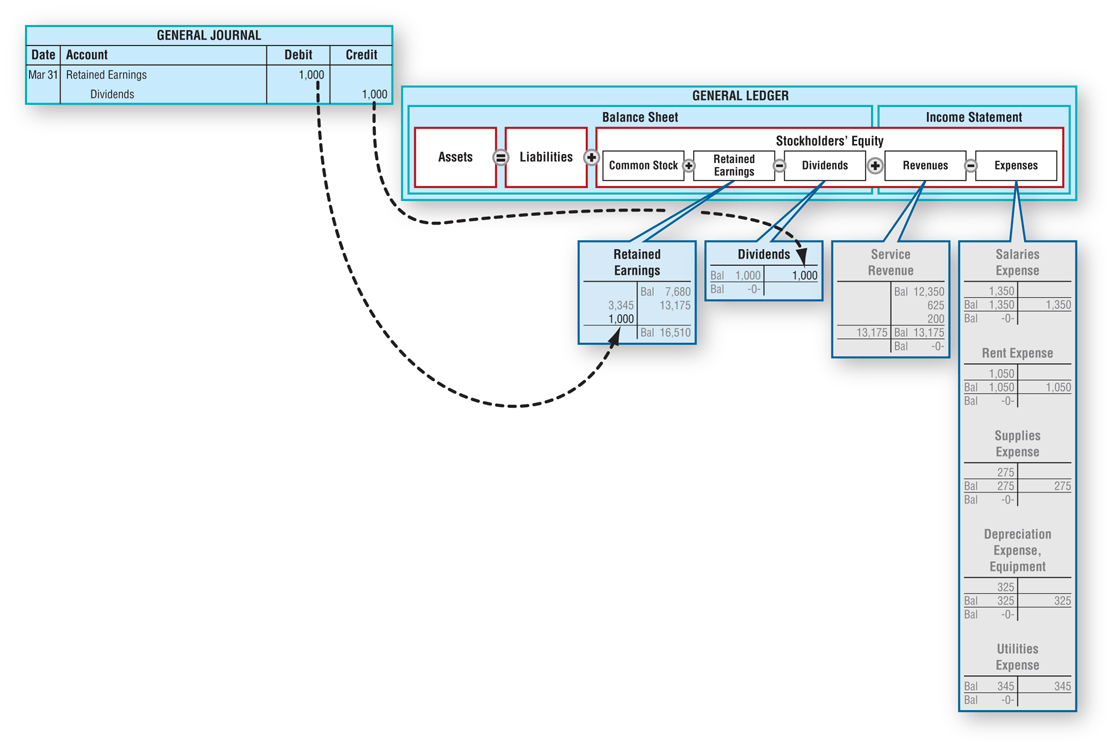
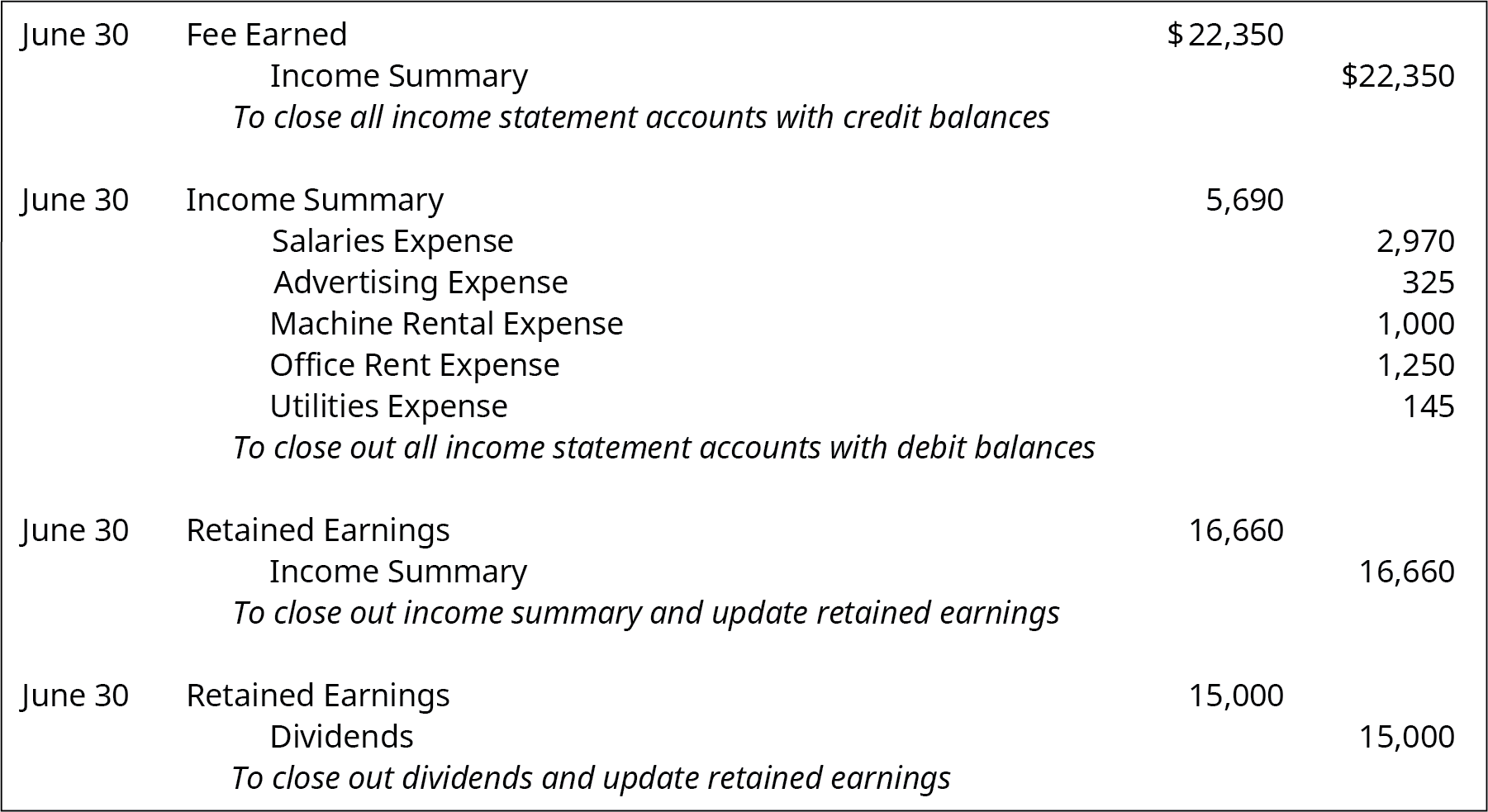
Once adjusting entries have been made, closing entries are used to reset temporary accounts. The first entry closes revenue accounts to the Income Summary account. The second entry closes xerocon san diego 2019 expense accounts to the Income Summary account. The third entry closes the Income Summary account to Retained Earnings. The fourth entry closes the Dividends account to Retained Earnings.

Steps 1 through 4 were covered in Analyzing and Recording Transactions and Steps 5 through 7 were covered in The Adjustment Process. Closing entries are the journal entries used at the end of an accounting period. Do you want to learn more about debit, credit entries, and how to record your journal entries properly?

To determine the income (profit orloss) from the month of January, the store needs to close theincome statement information from January 2019. Once all the adjusting entries are made the temporary accounts reflect the correct entries for revenue, expenses, and dividends for the accounting year. We can also see that the debit equals credit; hence, it adheres to the accounting principle of double-entry accounting. Suppose a business had the following trial balance before any closing journal entries at the end of an accounting period.

Having a zero balance in theseaccounts is important so a company can compare performance acrossperiods, particularly with income. Closing journal entries are used at the end of the accounting cycle to close the temporary accounts for the accounting period, and transfer the balances to the retained earnings account. Notice that revenues, expenses, dividends, and income summary all have zero balances.

By jailam

http://cse.google.mk/url?q=https://t.me/s/bonus_za_registratsiyu_bez_depa

Leave a Reply

Your email address will not be published. Required fields are marked *