Categories
Bookkeeping

Notes Receivable in Accounting

notes receivable journal entry

Your company receives a $10,000, 4 year, 2% annual interest note, paid semi-annually. The payee is the party who receives payment under the terms of the note, and the maker is the party obligated to send funds to the payee. The amount of payment to be made, as listed in the terms of the note, is the principal. This adjusting journal entry is needed to conform to GAAP, recording revenue in the month it is earned. Since cash isn’t changing hands until later, we record the amount in the Interest Receivable account to keep track of what will be due. But, briefly, if a bank is loaning cash (the bank’s Note Receivable) to a customer (the customer’s Note Payable), the credit would be to Cash for the bank.

What is an Asset?

This is because not all the sales made to a particular customer are recorded in the customer’s subsidiary accounts receivable ledger. The note has now been completely paid off, and ABC has recorded a total of $246 in interest income over a three-month period. Accruing state unemployment insurance sui rates tax liabilities in accounting involves recognizing and recording taxes that a company owes but has not yet paid. This is important for accurate financial reporting and compliance with… The $18,675 paid by Price to Cooper is called the maturity value of the note.
notes receivable journal entry

Interest Rate

  • The difference between a short-term note and a long-term note is the length of time to maturity.
  • Notes receivable refers to a written, unconditional promise made by an individual or business to pay a definite amount at a definite date or on demand.
  • For this reason, both IFRS and ASPE allow net realizable value (the net amount expected to be received in cash) to approximate the fair value for short-term notes receivables that mature within one year.
  • Together, the principal and interest portions represent the note’s maturity value.
  • For example, if the interest rate (I/Y) is not known, it can be derived if all the other variables in the equation are known.

In this article we dive into an example of how to do a Notes Receivable calculation, using both IFRS and ASPE methods.

Accounting in the Headlines

Interest Income or Interest Revenue is an Revenue account so it has a normal credit balance. Interest Income or Interest Revenue is increased on the credit (right) side of the account and decreased on the debit (left) side of the account. The account name used will be specified in the company’s Chart of Accounts. A Note Receivable is recorded when a company is on the “receiving” side of a debt.

This difference would be deemed as additional compensation and recorded as Compensation expense. The implied interest rate is calculated to be 5% and the note’s interest component (rounded) is $2,165 (), which is the difference between the cash lent and the higher amount of cash repaid at maturity. Below is the schedule for the interest and amortization calculations using the effective interest method. A note receivable is a promissory note made by a maker to a payee promising to repay a specified amount at a future time. However, the accounting entry will follow if the company converts an accounts receivable balance to a note receivable. Finally, a note receivable will also mention the timeframe of the loan.

Do you already work with a financial advisor?

On 1 May 20X4, PQR, Inc. lent $2 million to ABC, LLC for 2 years against a documented promissory note. DEF, Inc., another client of PQR, Inc. issued a 2-month promissory note against their outstanding balance of $3 million on 1 November 20X4. Note receivable from ABC LLC carried 5% simple interest rate payable annually while the one from DEF Inc. carried 8% interest compounded monthly.

Notes receivable also arise when a business lends an amount to another party against a documented promise to pay it back. The difference between a short-term note and a long-term note is the length of time to maturity. As the length of time to maturity of the note increases, the interest component becomes increasingly more significant. As a result, any notes receivable that are greater than one year to maturity are classified as long-term notes and require the use of present values to estimate their fair value at the time of issuance. After issuance, long-term notes receivable are measured at amortized cost.

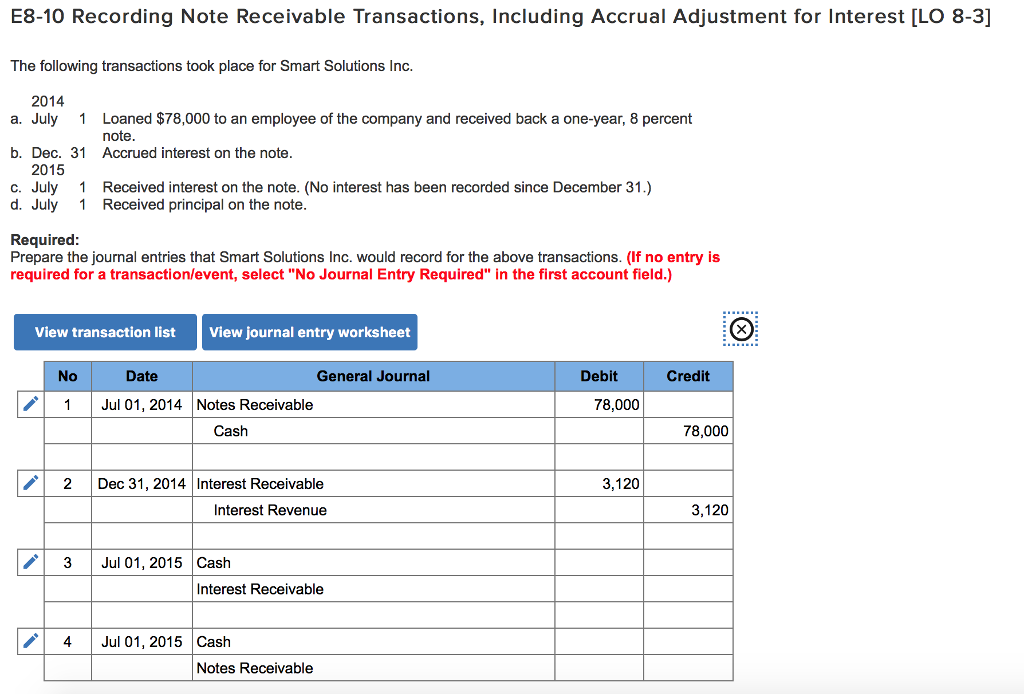
Interest Receivable decreasing (credit) reflects the 2018 interest owed from the customer that is paid to the company at the end of 2019. The second possibility is one entry recognizing principal and interest collection. Interest on a note receivable is calculated by multiplying the principal balance of the note by the interest rate and by the number of days that have elapsed since the last interest payment was made divided by 365. With a promissory note, the third party who issued the note (called the maker) promises in writing, to pay an amount of money (principal and interest) to the business (called the payee) at a given time or on demand. The accounting treatment of interest that is accrued but remains unpaid up to balance sheet date, depends on whether the interest is compound or simple.

At the maturity date of a note, the maker is responsible for the principal plus interest. The payee should record the interest earned and remove the note from its Notes Receivable account. Thus, the payee of the note should debit Accounts Receivable for the maturity value of the note and credit Notes Receivable for the note’s face value and Interest Revenue for the interest.

Sometimes a company receives a note when it sells high-priced merchandise; more often, a note results from the conversion of an overdue account receivable. When a customer does not pay an account receivable that is due, the company may insist that the customer  gives a note in place of the account receivable. This action allows the customer more time to pay the balance due, and the company earns interest on the balance until paid. Also, the company may be able to sell the note to a bank or other financial institution.

Notes receivable refers to a written, unconditional promise made by an individual or business to pay a definite amount at a definite date or on demand. On March 31 a similar entry will be made to record the interest revenue earned in March. On February 28 a similar entry will be made to record the interest revenue earned in February. In this journal entry, the Accounts Receivable invoice for Dino-Kleen is reduced to take the invoice out of Accounts Receivable. It will no longer appear on Accounts Receivable reports or be included in the Accounts Receivable total.

Categories
Bookkeeping

6 3.2: Notes Receivable Business LibreTexts

notes receivable journal entry

Notes receivable are initially recognized at the fair value on the date that the note is legally executed (usually upon signing). The articles and research support materials available on this site are educational and are not intended to be investment or tax advice. All such information is provided solely for convenience purposes only and all users thereof should be guided accordingly.

notes receivable journal entry

Get in Touch With a Financial Advisor

The Statement of Financial Position (a.k.a Balance Sheet using Canadian ASPE accounting standards) presents the company’s total assets,… Interest Receivable is an Asset account so it has a normal debit balance. Interest Receivable is increased on the debit (left) side of the account and decreased on the credit (right) side of the account. Notes Receivable is an Asset account so it has a normal debit balance. Notes Receivable is increased on the debit (left) side of the account and decreased on the credit (right) side of the account.

What is the approximate value of your cash savings and other investments?

Square has recently gotten into lending money to its customers through its Square Capital program. According to Business Insider (April 15, 2015 article), Square has paid out over $100 million in small business financing over the past year. Notes receivables are similar to loans given by a company rather than credit due to its operations.

What is your current financial priority?

  • Such notes can arise from a variety of circumstances, not the least of which is when credit is extended to a new customer with no formal prior credit history.
  • If it is a compound interest, the accrued interest that remains unpaid is added to the principal of note receivable and carried over to the next accounting period.
  • The implied interest rate is calculated to be 5% and the note’s interest component (rounded) is $2,165 (), which is the difference between the cash lent and the higher amount of cash repaid at maturity.
  • This is the concept of the time value of money in which the present value of the note will increase bit by bit as the time passes until it reaches the end of the note maturity when the note is honored.

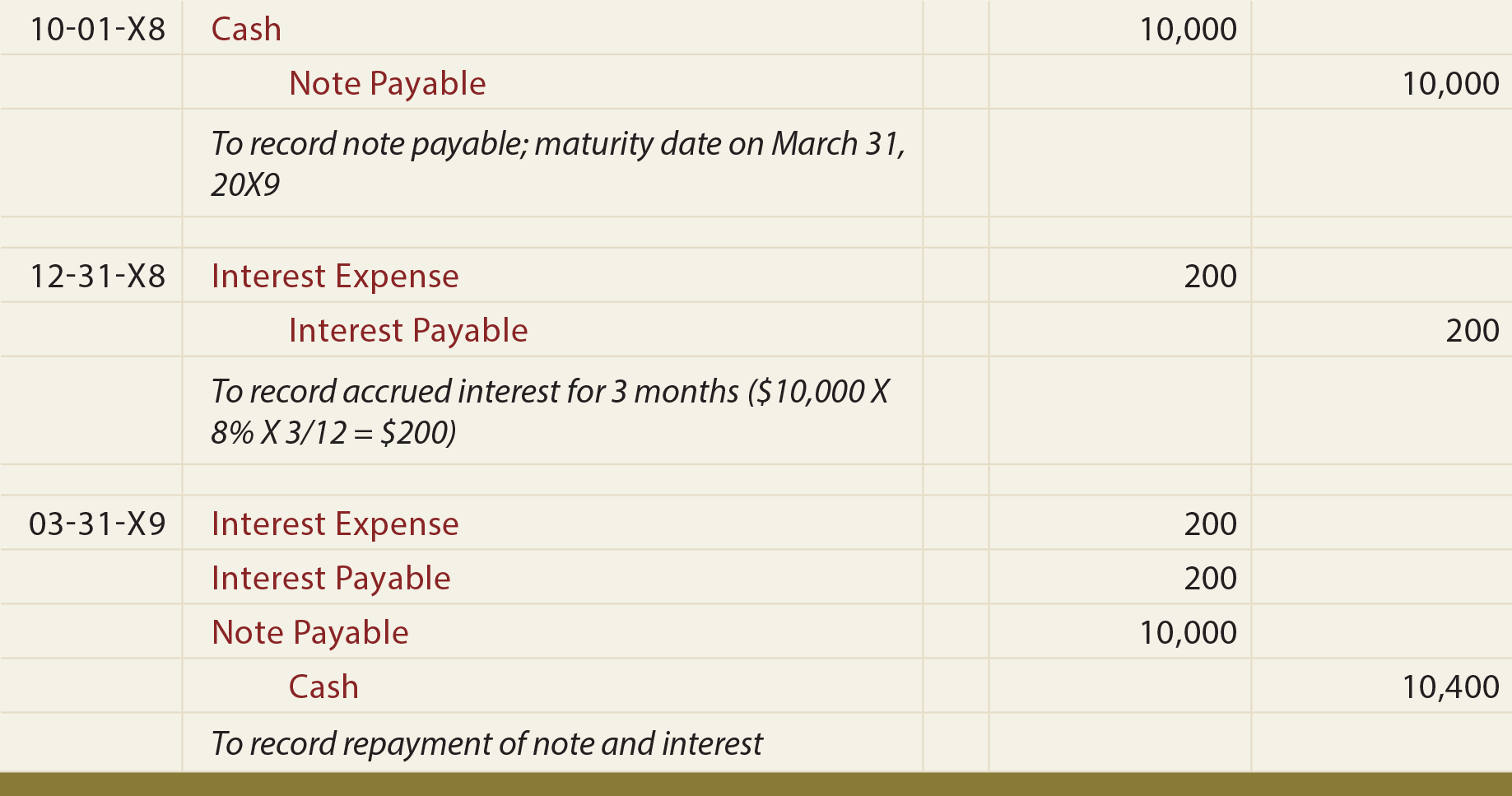
It is different from the interest-bearing note where its face value usually represents the present value and its maturity value is the total of the face value and the interest. On the other hand, the face value of the non-interest-bearing note is the maturity value itself as it does not have interest attached. The Interest Receivable amount of $124 is reducing the Interest Receivable account to show that the interest has been paid. Note Receivable amount represents the payment in full for the Note Receivable.

If a company is selling to its customer and issuing a Note Receivable rather than an Accounts Receivable, a Revenue account would be credited to record the revenue. When interest will be paid on a Note Receivable is specified in the promissory note. The note may specify that the interest is due at the maturity of the note. Or, it may specify that interest will be due at certain points during the note’s duration (monthly, quarterly, semi-annually).

Balance Sheet

The debit to Accounts Receivable reflects the hope of eventually collecting all amounts due, including interest. If Butchko anticipated difficulty collecting the receivable, appropriate allowances would be established in a fashion similar to those illustrated earlier in the chapter. For example, a company may provide a loan to another company in exchange for a note. The Fenton Company should also indicate the default on the Zoe Company’s subsidiary accounts receivable ledger.

Thus, a company may have notes receivable or notes payable arising from transactions with customers, suppliers, banks, or individuals. Remember from earlier in the chapter, a note (also called a promissory note) is an unconditional written promise by a borrower to pay a definite sum of money to the lender (payee) on demand or on a specific date. The total discount $480 amortized in the schedule is equal to the difference between the face value of the note of $10,000 and the present value of the note principal and interest of $9,250. The amortized discount is added to the note’s carrying value each year, thereby increasing its carrying amount until it reaches its maturity value of $10,000. As a result, the carrying amount at the end of each period is always equal to the present value of the note’s remaining cash flows discounted at the 12% market rate. This is consistent with the accounting standards for the subsequent measurement of long-term notes receivable at amortized cost.

In most cases, the transaction between the issuer and acquirer of the note is at arm’s length, so the implicit interest rate would be a reasonable estimate of the market rate. At month-end adjusting entry, the company can make the journal entry to increase the balance of the note receivable by debiting the note receivable with the amount of present value multiplying with the discount rate. Dino-Kleen, a customer of Terrance Inc. owes a $10,000 invoice that is past due.

Even though there is no cash inflow, the company records the credit of interest income here in the amount of the present value multiplying with the discount rate. This is the concept of the time value of money in which the present value of the note will increase bit by bit as the time passes until it reaches the end of the note maturity when the note is honored. In this journal entry, the amount of note receivable is the fair value of the note what is the purpose of the cash flow statement which is the present value of the note’s face value. Likewise, the company needs to calculate the present value which is the amount to be recorded in this journal entry by discounting the note’s face value to the present date using an appropriate discount rate. You should classify a note receivable in the balance sheet as a current asset if it is due within 12 months or as non-current (i.e., long-term) if it is due in more than 12 months.

The credit can be to Cash, Sales, or Accounts Receivable, depending on the transaction that gives rise to the note. To determine the duration of the notes, both the dates of the notes and their maturity dates must be known. For example, a note dated 15 July with a maturity date of 15 September has a duration of 62 days, as shown below. The “10%/12” here is to determine the monthly rate as the maturity period of the note is 3 months. A company’s auditors will examine the classification of notes receivable from the most conservative perspective, and so will insist on their classification as short-term if there are reasonable grounds for doing so. Cash amount equals the $10,000 face value of the amount of the note receivable plus the full amount of the interest being paid.

Categories
Bookkeeping

What is the Net 30 Payment Terms

net 30 payment terms

Here are the pros and cons of net 30 terms and whether you should offer them. When a product is sold or a service is given, you provide an invoice with payment terms indicating Net 30. Net 30 is a common payment term for businesses that sell to other businesses. Nav’s complete guide to net-30 accounts will help you find accounts that can help you build business credit, whether your business is brand new or well-established.

  • We believe everyone should be able to make financial decisions with confidence.
  • As a supplier of goods and services, you can now understand why managing just the credit checking process would cost your internal accounting, sales, and AR team a lot of time.
  • Start your free trial with Shopify today—then use these resources to guide you through every step of the process.
  • These 30 days are calendar days (not business days), so it includes weekends, holidays, and working days.
  • Her approach allows her to order $2,000 in supplies monthly, sell products she buys to customers, and pay for a significant portion of that inventory from cash flow.

Tips for Improving Your Net Terms/Net 30 Process

You can customize them based on your industry, client’s history, cash flow, and how much you’re owed. About half of all invoices issued by small businesses are Accounting for Churches paid at least two weeks late. More often than not, this is because they’re trying to increase their cash flow — but even with good intentions, this doesn’t always bode well. In the U.K., the invoicing term “net 30, end of the month” is also common. This means the invoice is due at the end of the month following the month of the invoice.

  • And in the case of “net 30,” it means you expect to be paid in full within 30 days.
  • For instance, if you receive an invoice in December, you must pay it by the end of January.
  • It’s a great way to potentially get paid faster, since the easier it is, the more likely clients will pay you straight away.
  • When the net is used separately without any number, then it denotes the customer how much they will be paying for an item or service before taxes.
  • Some suppliers will not extend credit to sole proprietorships.
  • Payments made 30 days after invoice date must include this service charge to be considered fully paid.
  • Many software choices have templates and features that help you create professional invoices with Net 30 terms quickly.

Should You Use Net 30 Payment Terms?

These arrangements are commonly known as net terms, and can help grow a customer base and improve revenue. Any business that is low on cash can procure good on Net terms while any business that is financially secure enough to offer grace period payment can provide Net terms. This means that the customer would get a 2% discount if the payment is made within 10 days from the day when the invoice was issued otherwise net is due in 30 days. Fortunately, several financing options are available to small business owners that allow them to offer their customers more options while still maintaining their cash flow. There are a few important things to keep in mind for payment terms wording. First and foremost, it’s essential to spell out the terms on every invoice.

What Does Net 30 Mean on an Invoice?

net 30 payment terms

It’s important to weigh the benefits and risks before deciding to use net 30 terms. Consider requesting extended payment terms, such as net-60 or net-90, to give yourself more time to pay invoices. Whether net 30 terms are suitable for you depends on your financial situation and industry standards.

Are net 30 terms right for your business?

  • Access Xero features for 30 days, then decide which plan best suits your business.
  • This can lead to honest payment mistakes that sour the relationship, or it can create more work for your team in explaining exactly what the terms mean.
  • Typically, net 30 payment refers to the customer’s obligation to pay within 30 calendar days from the invoice date.
  • As a business owner, when you use net 30 on an invoice to one of your customers, you encourage customers to create a positive payment history.
  • This content may include information about products, features, and/or services that SoFi does not provide and is intended to be educational in nature.
  • Whichever you prefer, knowing the ins and outs of payment terms like these can make or break your business.

It indicates when the vendor wants to be paid for the service or product provided. In net 30 payment terms this case, net 30 means the vendor wants to be paid within 30 days of the invoice date. If your business can handle the cash flow delay, this may be a smart move.

net 30 payment terms

For example, you could offer customers a payment term of “5% 10 net 30.” This means your customer receives a 5% discount if they pay their invoice within 10 calendar days. If they wait to pay their invoice on days 11 through 30, they’ll pay the full amount. Net 30 payment terms mean your customer has 30 days from the invoice date to pay you. It’s a common practice that allows customers a month to make a payment, offering flexibility and potentially strengthening business relationships.

If you’re an Invoice Simple user, Invoice Simple Payments lets you link your professional invoices to PayPal’s Pay in 4 service. This means you can offer net 30 terms without extending too much credit. As a business owner, you’re likely interested in using payment terms to land more customers. But they are equally beneficial for you to use in your business purchases. Regardless of how you calculate your payment terms, communicate them clearly to your customers to avoid confusion or late payments.

net 30 payment terms

Building a relationship with a trade credit vendor can help you purchase business supplies without breaking the bank. Another term for extending credit to customers is trade credit. This is a business-to-business agreement that works on payment terms, unearned revenue often net 30, 60, or 90. All rates, fees, and terms are presented without guarantee and are subject to change pursuant to each provider’s discretion.

net 30 payment terms

Adding a note on a line or two is all it takes to convert a standard invoice into one that offers net 30 terms. The key benefit of invoice factoring is that it gives you access to working capital faster. However, the convenience of fast cash comes at cost that can erode your profit. Our intuitive software automates the busywork with powerful tools and features designed to help you simplify your financial management and make informed business decisions.

Categories
Bookkeeping

Closing Entries: Step by Step Guide

closing entries example

Understanding the accounting cycle and preparing trial balances is a practice valued internationally. The Philippines Center for Entrepreneurship and the government of the Philippines hold regular seminars going over this cycle with small business owners. They are also transparent with their internal trial balances in several key government offices. Check out this article talking about the seminars on the accounting cycle and this public pre-closing trial balance presented by the Philippines Department of Health. Closing entries are put into action on the last day of an accounting period. There are various journals for example cash journal, sales journal, purchase journal etc., which allow users to record transactions and find out what caused changes in the existing balances.

The Most Important Financial Reports for Small Businesses

Finally, transfer any dividends to the retained earnings account. In short, we can clear all temporary accounts to retained earnings with a single closing entry. By debiting the revenue account and crediting the dividend and expense accounts, the balance of $3,450,000 is credited to retained earnings. The retained earnings account balance has now increased to 8,000, and forms part of the trial balance after the closing journal entries have been made. This trial balance gives the opening balances for the next accounting period, and contains only balance sheet accounts including the new balance on the retained earnings account as shown below.

Permanent versus Temporary Accounts

  • The account is then cleared out and transferred to retained earnings, which we will explain.
  • Then, just pick the specific date and year you want the closing process to take place, and you’re done!
  • In addition, if the accounting system uses subledgers, it must close out each subledger for the month prior to closing the general ledger for the entire company.
  • In this example we will close Paul’s Guitar Shop, Inc.’s temporary accounts using the income summary account method from his financial statements in the previous example.
  • The Income Summary account has a new credit balance of $4,665, which is the difference between revenues and expenses (Figure 5.5).
  • The use of closing entries resets the temporary accounts to begin accumulating new transactions in the next period.

The post-closing T-accounts will be transferred to the post-closing trial balance, which is step 9 in the accounting cycle. This means that it is not an asset, liability, stockholders’ equity, revenue, or expense account. The account has a zero balance throughout the entire accounting period until the closing entries are prepared.

What Is Net Income?

In this case, we can see the snapshot of the opening trial balance below. Since the income summary account is only a transitional account, it is also acceptable to close directly to the retained earnings account and bypass the income summary account entirely. Companies are required to close their books at the end of each fiscal year so that they can prepare their freelance accounting jobs employment annual financial statements and tax returns. It’s important to carefully follow each step of the closing process in order to properly close the books at the end of an accounting period. If your company doesn’t have dividends then you won’t need to do this step. If it does, you’ll need to debit retained earnings and credit dividends like in the example here.

It is permanent because it is not closed at the end of each accounting period. At the start of the new accounting period, the closing balance from the previous accounting period is brought forward and becomes the new opening balance on the account. Other than the retained earnings account, closing journal entries do not affect permanent accounts. The statement of retained earnings shows the period-ending retained earnings after the closing entries have been posted.

The term “net” relates to what’s left of a balance after deductions have been made from it. Retained earnings are defined as a portion of a business’s profits that isn’t paid out to shareholders but is rather reserved to meet ongoing expenses of operation. My Accounting Course  is a world-class educational resource developed by experts to simplify accounting, finance, & investment analysis topics, so students and professionals can learn and propel their careers.

closing entries example

In other words, they represent the long-standing finances of your business. That’s exactly what we will be answering in this guide –  along with the basics of properly creating closing entries for your small business accounting. When you make closing accounting entries, you can follow the same steps. We are going to go over these at a high level and then jump into each step individually.

After the posting of this closing entry, the income summary now has a credit balance of $14,750 ($70,400 credit posted minus the $55,650 debit posted). The purpose of closing entries is to merge your accounts so you can determine your retained earnings. Retained earnings represent the amount your business owns after paying expenses and dividends for a specific time period. Temporary account balances can be shifted directly to the retained earnings account or an intermediate account known as the income summary account. At the end of the year, all the temporary accounts must be closed or reset, so the beginning of the following year will have a clean balance to start with. In other words, revenue, expense, and withdrawal accounts always have a zero balance at the start of the year because they are always closed at the end of the previous year.

Categories
Bookkeeping

Closing Entries: Step by Step Guide

closing entries example

Net income is the portion of gross income that’s left over after all expenses have been met. The term can also mean whatever they receive in their paycheck after taxes have been withheld. Shaun Conrad is a Certified Public Accountant and CPA exam expert with a passion for teaching.

Step 1: Close all income accounts to Income Summary

Doing so automatically populates the retained earnings account for you, and prevents any further transactions from being recorded in the system for the period that has been closed. Closing entries are journal entries made at the end of an accounting period, that transfer temporary account balances into a permanent account. The purpose of closing entries is to prepare the temporary accounts for the next accounting period. In other words, the income and expense accounts are “restarted”. Closing journal entries are made at the end of an accounting period to prepare the accounting records for the next period.

How to close an income summary account?

A closing entry is a journal entry made at the end of an accounting period. It involves shifting data from temporary accounts on the income statement to permanent accounts on the balance sheet. These accounts must be closed at the end of the accounting year. The balance in dividends, revenues and expenses would all be zero leaving only the permanent accounts for a post closing trial balance. The trial balance shows the ending balances of all asset, liability and equity accounts remaining. The main change from an adjusted trial balance is revenues, expenses, and dividends are all zero and their balances have been rolled into retained earnings.

closing entries example

What Is Net Income?

In summary, the accountant resets the temporary accounts to zero by transferring the balances to permanent accounts. A temporary account is an income statement account, dividend account or drawings account. It is temporary because it lasts only for the accounting period. At the end of the accounting period, the balance is transferred to the retained earnings account, and the account is closed with a zero balance. For each temporary account there will be a closing journal entry.

Closing entries transfer the balances from the temporary accounts to a permanent or real account at the end of the accounting year. In this case, if you paid out a dividend, the balance would be moved to retained earnings from the dividends account. Once this has been completed, a post-closing trial balance will be reviewed to ensure accuracy. A business will use closing entries in order to reset the balance of temporary accounts to zero. Let’s investigate an example of how closing journal entries impact a trial balance.

Ready to Experience the Future of Finance?

As we mentioned, the income summary is a temporary account in itself. You will start by clearing out the income accounts from the income statement (revenue) and crediting the income summary. First, you are going to start by identifying the temporary accounts that need to be closed. As we mentioned, these include revenue, expense, and dividend accounts. Only incomestatement accounts help us summarize income, so only incomestatement accounts should go into income summary.

  • The Printing Plus adjusted trial balance for January 31, 2019, is presented in Figure 5.4.
  • The next day, January 1, 2019, you get ready for work, butbefore you go to the office, you decide to review your financialsfor 2019.
  • They’re housed on the balance sheet, a section of financial statements that gives investors an indication of a company’s value including its assets and liabilities.

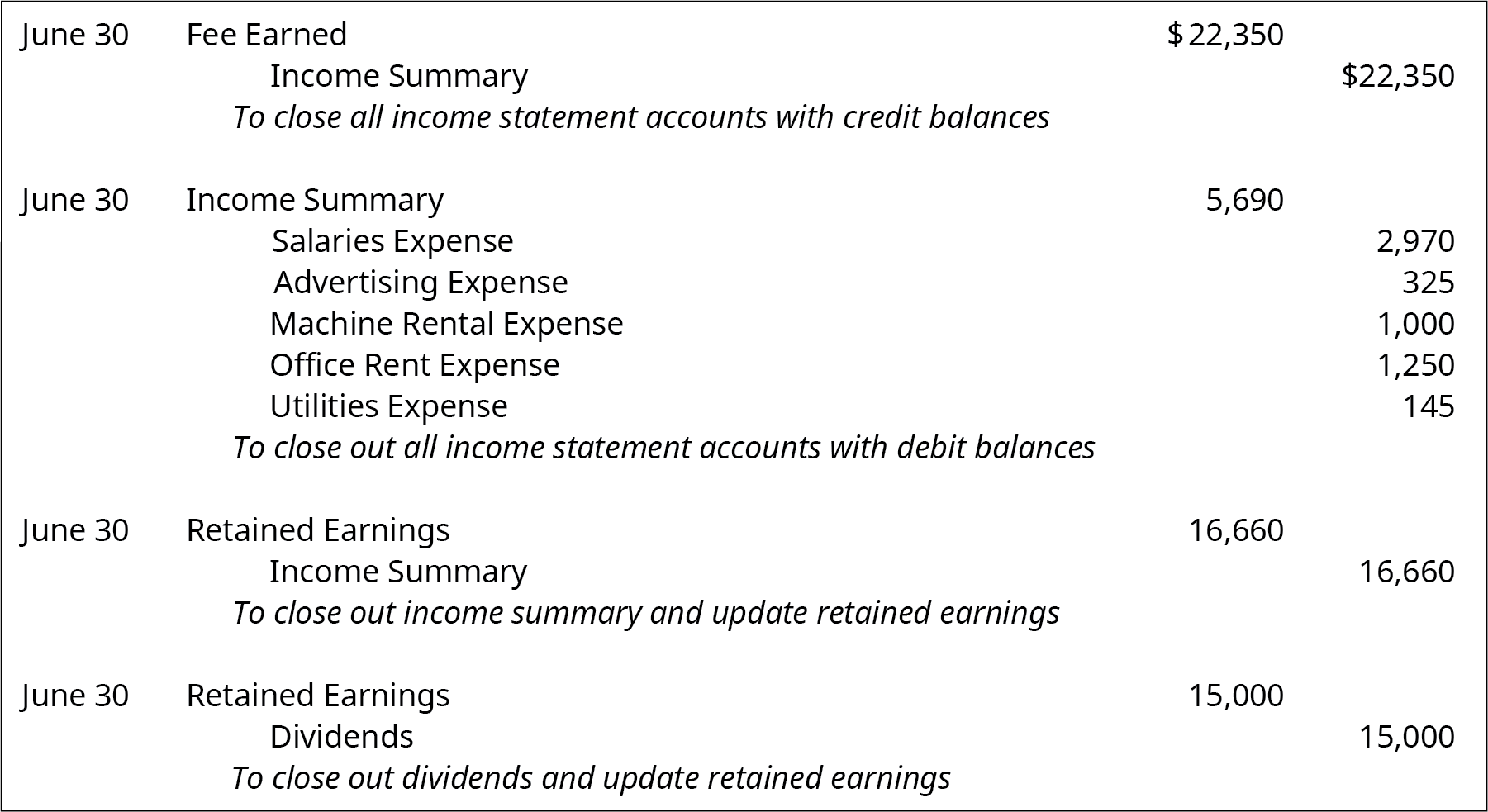
Once adjusting entries have been made, closing entries are used to reset temporary accounts. The first entry closes revenue accounts to the Income Summary account. The second entry closes xerocon san diego 2019 expense accounts to the Income Summary account. The third entry closes the Income Summary account to Retained Earnings. The fourth entry closes the Dividends account to Retained Earnings.

Steps 1 through 4 were covered in Analyzing and Recording Transactions and Steps 5 through 7 were covered in The Adjustment Process. Closing entries are the journal entries used at the end of an accounting period. Do you want to learn more about debit, credit entries, and how to record your journal entries properly?

To determine the income (profit orloss) from the month of January, the store needs to close theincome statement information from January 2019. Once all the adjusting entries are made the temporary accounts reflect the correct entries for revenue, expenses, and dividends for the accounting year. We can also see that the debit equals credit; hence, it adheres to the accounting principle of double-entry accounting. Suppose a business had the following trial balance before any closing journal entries at the end of an accounting period.

Having a zero balance in theseaccounts is important so a company can compare performance acrossperiods, particularly with income. Closing journal entries are used at the end of the accounting cycle to close the temporary accounts for the accounting period, and transfer the balances to the retained earnings account. Notice that revenues, expenses, dividends, and income summary all have zero balances.

Categories
Bookkeeping

Bookkeeping for Nonprofits: A Complete Guide

bookkeeping for nonprofit organizations

The Internal Revenue Service (IRS) is responsible for overseeing these organizations and ensuring they comply with applicable tax laws. Nonprofits must follow Generally Accepted Accounting Principles (GAAP), established by the Financial Accounting Standards Board (FASB), to prepare accurate and consistent financial statements. This allows donors, board members, and other stakeholders to assess the organization’s performance and financial stability. Organizing and maintaining receipts is essential for transparent and accurate financial reporting and ensures you’re audit-ready. It ensures their finances are managed responsibly, maintains compliance with regulations, and provides insights to make informed decisions. Key components include a well-structured chart of accounts, fund accounting, accurate tracking of donor contributions and grants, and regular financial reporting.

Tools and Software for Non Profit Bookkeeping

Effective bookkeeping is crucial for legal compliance and transparent reporting, informed decision-making, and fostering trust among donors and 5 Main Benefits of Accounting Services for Nonprofit Organizations stakeholders. The primary goal of nonprofit accounting is to ensure that funds are used efficiently and effectively to support the organization’s mission. This involves tracking income from various sources such as donations, grants, and fundraising events, while also monitoring expenses to ensure alignment with budgetary constraints. By maintaining accurate financial records, nonprofits can demonstrate their financial health and build trust with their supporters. Nonprofit accounting refers to the specialized financial management practices designed to meet the unique needs of nonprofit organizations.

bookkeeping for nonprofit organizations

Accounting Software

At the core of nonprofit accounting are the financial statements, which typically include the Statement of Financial Position, Statement of Activities, and Statement of Cash Flows. S assets, liabilities, revenues, and expenses, allowing stakeholders to assess its financial stability. Additionally, nonprofits must prepare budgets that reflect their strategic goals and operational plans. Additionally, nonprofit accounting helps organizations comply with legal and regulatory requirements. Nonprofits are often subject to specific financial reporting standards and must adhere to guidelines set by governing bodies.

bookkeeping for nonprofit organizations

Small Businesses

bookkeeping for nonprofit organizations

This process helps identify and correct discrepancies, preventing potential issues down the line. This is why we encourage you to learn about the three primary financial statements and utilize a budget. Understanding financial statements and budgeting will help https://greatercollinwood.org/main-benefits-of-accounting-services-for-nonprofit-organizations/ you plan and strategize for the future of your organization. Ask your bank about your options regarding not-for-profit accounts or check out this list of best non-profit bank accounts. When you outsource your bookkeeping you not only save time, but get accurate financial insights so you can make informed decisions for your business.

bookkeeping for nonprofit organizations

bookkeeping for nonprofit organizations

Nonprofit accounting, similar to other aspects of your nonprofit’s strategy, requires your organization to compile several key reports and documents to organize your financial data. In the intricate world of nonprofit management, sound financial practices are the bedrock of success. As your organization strives to make a positive impact, having a trusted partner for nonprofit accounting is paramount. Organized record-keeping is crucial for accounting audits, compliance reviews, and financial analysis.

  • Whereas, nonprofit organizations need to monitor multiple sources, including fundraising events and grants, while maintaining their financial position.
  • Donor data is useful for building relationships, but it can clog up your accounting system.
  • As your nonprofit grows, you’ll likely need bookkeeping and accounting expertise.
  • It has an impressive suite of core features including billing and invoicing, collections, cash management, fixed asset management, and even payroll capabilities.
  • Linda Rost started Better Bookkeepers in 1999, and since then the team has worked for over two decades.
  • In addition, they can track expenses and capture receipts to simplify tax filings and report to donors the nonprofits’ overhead-versus-project costs.
  • Internal controls may include segregation of duties, regular bank reconciliations, and review processes for financial transactions.
  • These contributions have no stipulations and can be utilized freely to accomplish the organization’s diverse needs, be it operational costs, programs, or projects.
  • Learn the six essential steps that every nonprofit should take to determine the ideal reserve fund amount.

Nonprofit accounting is the unique process that charitable organizations use to plan, record, and report their finances. The core of nonprofit accounting is accountability, meaning your goal in your accounting practices should be ensuring honesty and transparency with your donors, other stakeholders, and the government. At ASNY, we are dedicated to establishing a resilient financial foundation for charter schools and nonprofit organizations by optimizing operations through accounting excellence. Some donations and grants will come into your organization restricted for specific purposes. Nonprofit fund accounting differs from for-profit accounting because it ensures accountability to the donors’ wants and tracks how these funds are allocated.

  • Understanding these fundamentals is vital to maintaining transparency, accountability, and trust among the stakeholders they serve.
  • Let’s review the unique bookkeeping requirements that relate to not for profits.
  • Their mission is usually anchored on a cause or social purpose, not on the generation of profits.
  • Being exempted from tax is one of the goals that nonprofit organizations have.
  • There is some overlap between bookkeeping and HR departments when it comes to payroll, but most small to mid-sized organizations delegate this task to the non-profit bookkeeper.

Revenue Recognition

You have to pay an extra fee for payroll services, starting at $45 per month. But when you’re trying to paste together your numbers with a part-time bookkeeper or a volunteer accountant, it’s nearly impossible to get the transparency you need to run your nonprofit organization. The Statement of Functional Expenses offers a more detailed view of how a nonprofit allocates its expenses across various functions. It categorizes the expenses by both nature (such as salaries, rent, or supplies) and function (program services, management, and fundraising). Nonprofits can indeed make a profit, as it is essential for their sustainability and continuity.